3. Rule Out Market and Economic Conditions
Lower replacement revenue doesn’t automatically mean your plumbing SEO has failed. Economic conditions can change how customers spend, even when your local SEO continues generating demand.
Higher interest rates and tighter budgets often lead homeowners to delay major purchases. Instead of replacing an aging system, many choose a repair to get through another season.
For plumbing companies, that means replacement work may slow while demand for plumbing services stays steady. A homeowner may postpone replacing a water heater but still call when an unexpected plumbing problem occurs.
Instead of focusing only on replacement revenue, compare your service-call volume year over year.
If service calls stay the same or increase while replacement revenue declines, changing customer behavior may be the bigger issue, not your marketing. But if both service calls and qualified organic inquiries are down, it’s time to take a closer look at your SEO strategy.
Market conditions may also require operational changes. You may need to rethink how your services are positioned, review your pricing, and find ways to increase revenue from each service visit.
Before deciding your plumbing SEO has stopped working, rule out changes in customer demand and spending habits first.
4. Audit Every Search Channel Separately and Remove Spam
Search marketing is not one combined channel. If you’re evaluating everything under a single “SEO” number, you’re likely missing where performance is changing.
For most plumbing companies, there are four primary search channels to evaluate separately:
- Google Local Service Ads
- Google Ads
- Google Business Profile
- The company website and its plumbing SEO
Each channel contributes differently to lead generation. Combining them into one report makes it difficult to determine which marketing efforts are producing results and which ones have stalled.
A common reporting issue occurs when agencies combine every search-related call and lead into one total. Overall numbers may appear stronger simply because the business increased spending on Local Service Ads, even while website traffic and local search rankings remain flat.
That’s why every channel deserves its own year-over-year comparison.
Review:
- Local Service Ads leads
- Google Ads leads
- Google Business Profile calls
- Website calls
- Website form submissions
- Organic search results
Then ask yourself one important question: Are search leads increasing because your organic SEO is improving, or are the numbers only higher because you’re spending more on paid advertising?
If Local Service Ads or Google Ads are producing nearly all the new activity while your website and Google Business Profile remain unchanged, your local SEO strategy likely needs attention.
If you’re running Local Service Ads, our guide on how to read and interpret Google LSA reports can help you evaluate channel performance more accurately.
Remove Spam From Google Business Profile Call Totals
Another issue affecting many local businesses is spam.
Call tracking attached to your Google Business Profile may include automated calls that never represented genuine customer inquiries. If those calls remain in your reporting, your search visibility may appear stronger than it actually is.
A common example is an automated recording claiming your Google Business Profile is not verified and instructing you to press or dial a number.
Those aren’t leads.
To understand how your plumbing business is really performing, audit at least one month of call recordings.
Separate:
- Spam calls
- Existing customers
- Repeat callers
- Genuine new plumbing inquiries
Once you’ve removed fake activity, recalculate your year-over-year numbers.
You’ll often discover that reported call growth looks very different after eliminating spam. That cleaner data makes it much easier to determine whether your plumbing SEO strategy is still improving or whether local search visibility has genuinely plateaued.
Without channel-specific reporting and clean call data, it’s impossible to know whether your search engine optimization campaign is actually slowing down.
5. Decide Whether You Need a Completely Different Local Search Strategy
If you’ve confirmed accurate reporting, separated marketing from sales, considered market conditions, and audited every search channel, the remaining issue may not be execution.
It may be your strategy.
Sometimes, a plumbing business doesn’t need small campaign adjustments. It needs a different SEO strategy that reflects how search engines, local competition, and customer behavior have changed.
Check Whether Proximity Has Reduced Your Reach
Start by identifying where your verified Google Business Profile is physically located.
Then compare that location with the neighborhoods and service areas that historically generated plumbing calls. If inquiries from certain parts of your local market have declined, nearby competitors may now be appearing more prominently because they’re physically closer to those searchers.
Google explains that local search results are primarily influenced by relevance, distance, and prominence. Distance considers how close a business is to the location used in a search, helping explain why businesses on one side of a city may lose visibility in another area.
One Google Business Profile may not provide equal local search visibility across an entire metropolitan area, especially in competitive markets.
“Google may start giving your competitors the market share your business used to receive because they’re closer to the customer.”

If you’ve ruled out reporting issues, proximity may be limiting your visibility more than your SEO efforts. That’s why it’s important to evaluate your review strategy alongside your location.
Increase Review Velocity, Not Just Lifetime Review Count
Next, evaluate your review system.
Ask yourself whether your business has:
- Automated review requests
- Technicians trained to ask customers for reviews
- CSR follow-up after service or installation
These systems encourage a steady flow of new customer feedback instead of relying on reviews earned years ago.
Review velocity matters more today than simply having a large lifetime review count. While Google publicly states that more reviews and positive ratings contribute to prominence, it does not publish a specific review-velocity formula.
From a practical standpoint, competitors consistently earning fresh reviews often appear more active and trustworthy to both customers and search engines.
Consider a Legitimate Second Google Business Profile
For established plumbing companies, there may be another option.
If your company is already earning hundreds of new reviews each year—not approximately 100—you may qualify for a legitimate second Google Business Profile serving another real operating location.
The goal isn’t to manipulate rankings. It’s to establish a genuine business presence closer to customers your original location struggles to reach because of distance.
Google’s guidelines require businesses to represent themselves accurately, maintain one profile per legitimate location, and keep addresses and service areas truthful.
This strategy has produced measurable results when implemented correctly.
One of our HVAC and plumbing clients increased total calls from 4,093 to 5,135 year over year—an increase of 1,042 calls (25.4%). Approximately 60% of that new call volume came from a legitimately established second Google Business Profile we helped establish.
Read the full case study here: HVAC and plumbing local SEO case study with 1,042 new calls.
Update the Strategy for Changes in Google and AI Search
Search behavior continues to evolve.
Today’s customers increasingly use platforms like ChatGPT, Gemini, and traditional Google Search when researching local businesses and comparing plumbing services online.
That doesn’t mean anyone outside Google knows exactly how AI influences rankings. It does mean that a plumbing SEO strategy delivering strong growth several years ago may no longer be enough to maintain the same online visibility today.
After ruling out reporting problems, sales issues, market conditions, and attribution errors, a stalled campaign often requires a substantially updated strategy rather than small tactical adjustments.
Use This Five-Point Plumbing SEO Audit
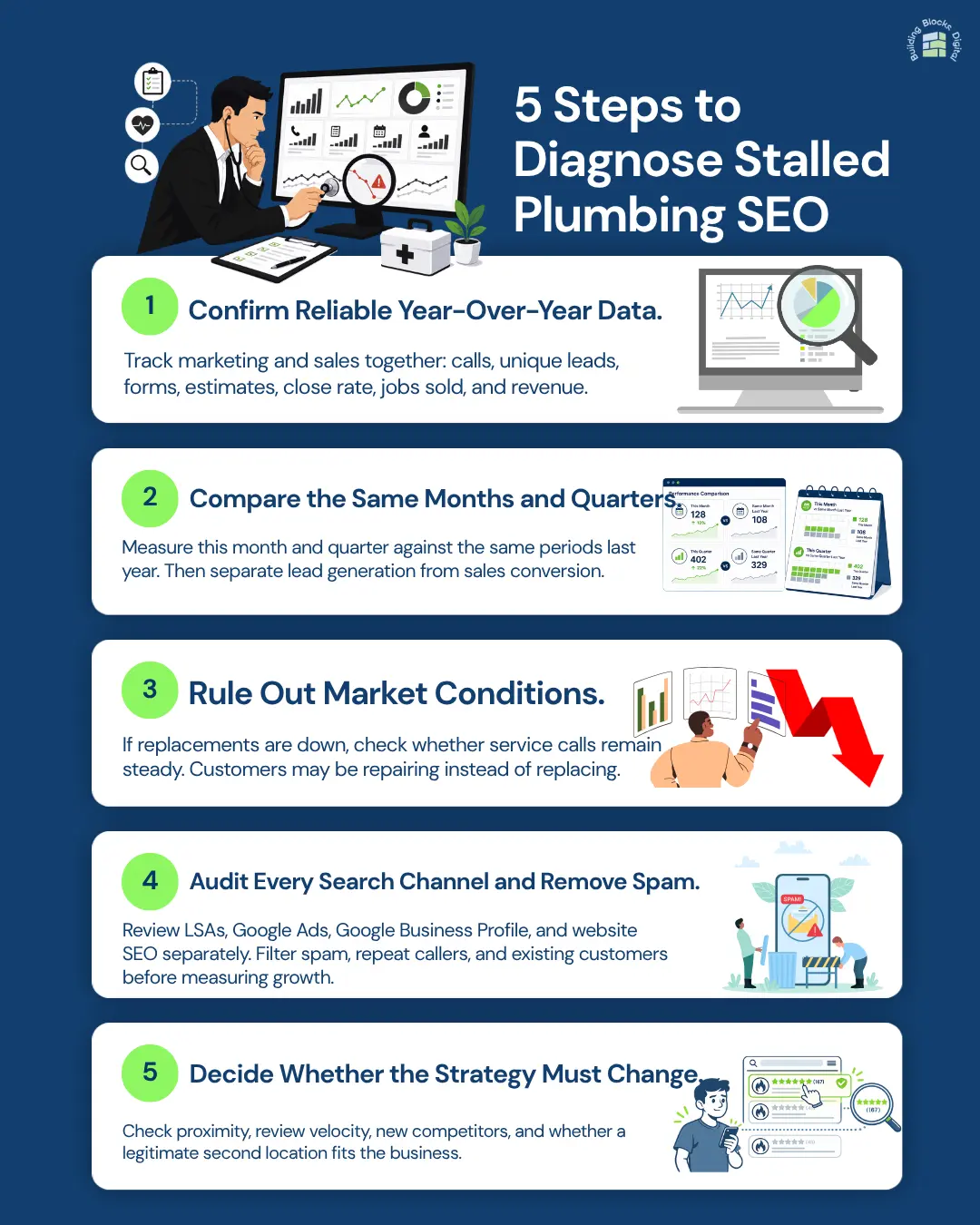
Before deciding your marketing has stopped working, run through these five factors:
- Confirm the Data: Gather year-over-year website, call, lead, sales, and revenue data. Remove spam before evaluating performance.
- Compare Months and Quarters: Compare the same month and quarter year over year. Separate marketing performance from sales conversion.
- Rule Out Market Conditions: Determine whether changing customer demand is affecting results before blaming your plumbing SEO.
- Audit Every Search Channel: Review Local Service Ads, Google Ads, Google Business Profile, and website SEO separately. Make sure paid advertising isn’t masking stagnant organic performance.
- Reassess the Strategy: Evaluate proximity, review activity, and whether your local SEO strategy still reflects changes in Google and AI-assisted search.
Completing this audit will help you identify whether your slowdown is caused by reporting, sales, market conditions, or a strategy that needs to evolve.
Get Your Plumbing SEO Back on Track
A plumbing SEO plateau should never be diagnosed using gut feelings alone. Start with reliable year-over-year data, compare the same months and quarters, separate marketing from sales, rule out changing market conditions, and audit each search channel before assuming SEO is the problem.
If those first four checks don’t explain the slowdown, the issue may not be execution; it may be your strategy.
At Building Blocks Digital, we help plumbing business owners audit search performance, evaluate call quality and attribution, assess Google Business Profile reach, analyze local competitors, and develop strategies built on measurable results.
Ready to find out what’s really holding your plumbing SEO back? Call Building Blocks Digital at (505) 365-1545 or use our contact form to schedule a plumbing SEO audit built on accountability, not assumptions.
Frequently Asked Questions
Why has my plumbing SEO stopped working?
A decline in plumbing SEO doesn’t always mean your campaign has failed. Before assuming SEO is the problem, compare year-over-year data, review your search engine results pages, and determine whether changing marketing strategies or local competition are affecting your results.
How can I tell if my plumbing SEO is generating real leads?
Separate website forms, Google Business Profile calls, Local Service Ads, and Google Ads instead of combining everything into one report. Also, verify that your business name, address, and phone number, local citations, local listings, and other online listings are accurate across local business directories to improve local visibility.
Should I compare plumbing SEO results monthly or quarterly?
Compare the same month year over year first, but use the same quarter year over year for the clearer trend. A 90-day comparison reduces the effect of unusual weather or one exceptional month.
Does my business location affect my Google Maps rankings?
Yes. Your local service area, proximity to where homeowners search, and consistent business information all influence your local visibility in search. Keeping accurate listings across platforms, including Apple Maps and other local directories, helps plumbing contractors compete more effectively.
Can a second Google Business Profile help my plumbing company grow?
It may help an established company reach customers beyond the original profile’s practical range, but the second profile must represent a legitimate operating location with accurate information and appropriate staffing.