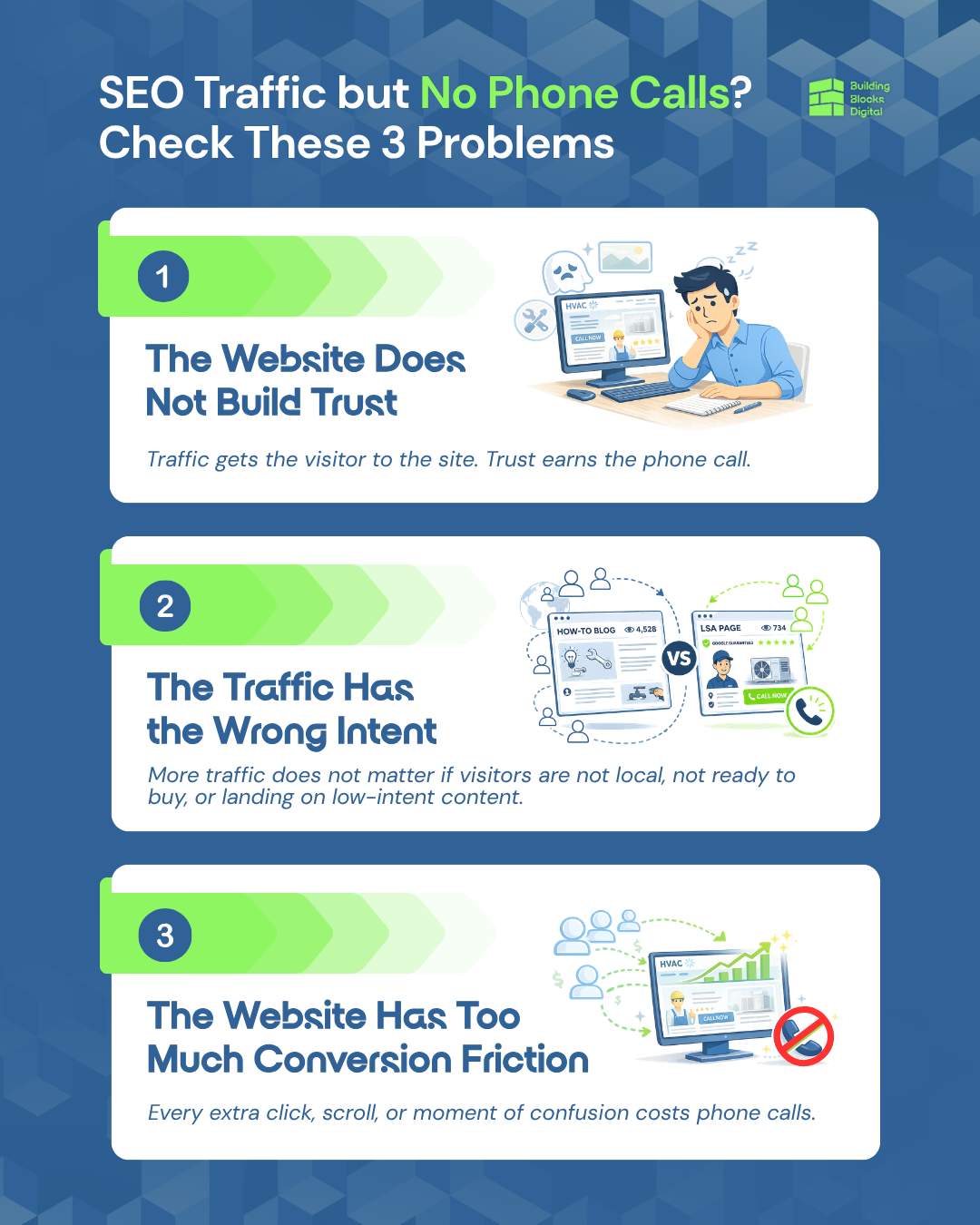
1. The Website Does Not Build Enough Trust
The first thing to evaluate isn’t your rankings. It’s whether your website gives homeowners confidence to call. A visitor may find you through local search, Google Maps, or organic search results, but if your HVAC website doesn’t immediately inspire trust, they’ll simply keep looking.
Start with one simple question:
Does your website make your HVAC company look professional and trustworthy?
Many business owners would say yes. After all, they’ve seen their website hundreds of times. But that’s exactly the challenge. When you look at something every day, it’s easy to miss the small details that shape a new visitor’s first impression.
That’s why a third-party review is often valuable. Someone seeing your website for the first time notices things you no longer see.
Trust begins with the overall quality of the site. A clean, modern design signals professionalism, while an outdated layout can raise doubts before someone reads a single word. Since many HVAC searches happen during stressful situations like an AC repair or furnace replacement, homeowners make quick decisions based on what they see.
Your website should also display trust signals throughout the customer journey, including:
- Better Business Bureau accreditation
- Local Chamber of Commerce membership
- HVAC manufacturer certifications
- Industry awards
- Partnerships with local organizations
- Community sponsorships
- Other recognizable trust badges
These elements reassure visitors that they’re dealing with an established local company—not just another contractor with a website.
Images play an equally important role.
“Use authentic photos of your technicians, vehicles, office, and completed work whenever possible. Stock photography and generic AI-generated images erode trust in a way that people can’t explain when they’re looking at it.”
Reviews deserve special attention as well. Most HVAC companies understand the importance of collecting online reviews, but many stop there. Your Google reviews should also appear prominently on your homepage and key service pages, giving visitors additional confidence before they decide to call.
Consistent review velocity also supports Google Business Profile performance and local SEO efforts, helping improve search visibility, Google Maps presence, and local rankings over time. More importantly, reviews act as powerful social proof that influences buying decisions.
When homeowners don’t immediately trust what they see, they often leave without contacting you—even if your HVAC SEO successfully brought them to the website.
Traffic gets the opportunity. Trust earns the phone call.
2. The Traffic Has the Wrong Search Intent
The second issue isn’t how much traffic you’re getting. It’s why people are arriving at your website in the first place.
Many HVAC companies celebrate increasing website traffic, but traffic alone doesn’t tell you whether your SEO strategy is producing business opportunities. To understand what’s happening, you need to examine Google Analytics, Google Search Console, and the pages driving your organic visitors.
Start by asking:
- Which pages receive the most traffic?
- Which search results and relevant keywords are bringing people in?
- Are visitors landing on revenue-generating service pages or informational blog posts?
This distinction matters more than many HVAC owners realize.
Imagine one visitor searches “how to change an air filter.”
Another searches “AC repair near me.”
Both visits increase your website traffic.
Only one is likely to become a phone call.
The same applies to someone searching how to flush a water heater or complete simple maintenance. Educational content can support search engine optimization, strengthen topical authority, and help your overall online visibility, but those visitors aren’t necessarily looking to hire an HVAC contractor today.
Location matters just as much. Someone reading your article from Alabama won’t become a customer if your HVAC business only serves California. Out-of-area traffic may improve reporting numbers, but it won’t generate local revenue.
That’s why service intent should always outweigh traffic volume.
Your separate service pages, dedicated landing pages, and location pages should target commercial searches tied directly to your HVAC services, air conditioning repair, duct cleaning, furnace replacement, and other high-intent services within your service areas.
“How people arrive at your website—and what brought them there—is more important than anything else when it comes to turning traffic into phone calls.”
That doesn’t mean informational content has no value.
Helpful blog posts can strengthen your on-page SEO, support keyword research, improve topical relevance, and help search engines better understand your expertise. They also give satisfied customers valuable educational resources.
The problem is that high website traffic doesn’t always mean better business results.
If most of your visitors are reading general how-to articles instead of your service pages, your traffic reports may look great, but they may not lead to more phone calls or customers.
When evaluating SEO performance, ask yourself three questions:
- Does this visitor actually need HVAC service?
- Are they located within my local market?
- Did they land on a page that represents a genuine revenue opportunity?
If the answer is “no,” that traffic probably won’t become phone calls, no matter how impressive the charts appear.
3. The Website Has Too Much Conversion Friction
Even when your organic traffic comes from the right audience, your HVAC website can still lose potential customers if it makes contacting your business harder than it needs to be.
Every additional click, scroll, or moment of confusion introduces friction, and friction costs phone calls.
One of the first things to evaluate is whether your phone number remains visible throughout the browsing experience.
Does your navigation stay with the visitor as they scroll?
Can someone call you from anywhere on the page?
Or do they have to scroll all the way back to the top just to find your contact information?
These details may seem minor, but they’re the difference between generating calls and losing opportunities, especially for homeowners dealing with emergency HVAC problems.
A sticky navigation with a click-to-call button makes it easy for visitors to contact you the moment they’re ready. Considering that most HVAC searches happen on mobile devices, keeping your contact information visible at all times reduces unnecessary friction and supports a better mobile experience.
Your calls to action should also appear throughout each service page, not just at the top. A homeowner may need to read about your process, guarantees, or experience before deciding to reach out. If the only opportunity to request service was at the beginning of the page, you’ve forced them to scroll back up or hunt for your contact page.
Instead, every important service page should make the next step obvious by offering multiple opportunities to:
- Call your business
- Request an estimate
- Submit a short contact form
- Schedule service online
Online scheduling deserves special attention.
Many HVAC searches happen after normal business hours. If someone lands on your website at 9:00 p.m. because their air conditioner has stopped working, they may not want to wait until morning to take action.
Integrating scheduling platforms like ServiceTitan, Jobber, or Housecall Pro allows visitors to book service immediately instead of moving on to another contractor.
Forms matter as well. Long forms asking for unnecessary information often discourage homeowners from reaching out. A simple request for essential details lowers friction and increases the likelihood of form submissions.
Another common issue is inconsistency between desktop and mobile experiences.
Many HVAC owners review their websites from a desktop computer at the office. Meanwhile, most potential customers are searching from smartphones. Navigation menus, buttons, page layouts, and click-to-call functionality can behave very differently on mobile devices. A page that works well on a computer may be harder to use on a phone
Website speed also plays a role. Emergency buyers will not wait for slow pages to load. A fast-loading website with strong technical SEO, proper speed optimization, optimized images, and healthy core web vitals not only improves user experience but also supports search engine rankings.
If visitors have to search for your phone number, navigate through multiple pages, or struggle with a confusing mobile layout, many simply leave. That lost opportunity won’t appear in your SEO report. It simply becomes the phone call your competitor receives instead.
A high-converting HVAC website makes contacting your business feel effortless.
Whether someone arrives through organic search, Google Ads, HVAC Google Ads, Google Business Profile, or another marketing channel, the next step should always be clear.
What Conversion Rate Should an HVAC Website Expect?
Understanding conversion rates helps put the traffic-versus-calls problem into perspective.
For this discussion, a conversion means a visitor contacting your business through a phone call, estimate request, contact form, or online scheduling action. These are the numbers that truly measure SEO success, not just increases in organic traffic or higher search engine rankings.
As a general benchmark for home service companies:
- 1% to 3% of visitors reaching out is a poor conversion rate.
- 5% to 10% is a good conversion rate for a local service business.
- More than 10% is an excellent conversion rate.
These benchmarks make sense because they reflect what happens when the entire customer journey works together.
The website builds trust.
The visitor arrives with the right search intent.
The website removes friction and makes contacting the business simple.
If any one of those pieces is missing, your call volume usually suffers.
One of the best ways to evaluate your SEO performance is to compare total organic search traffic against your actual leads. Review call tracking, phone calls, form submissions, online scheduling requests, and booked jobs. Segment blog traffic from service-page traffic, and review desktop and mobile performance separately whenever possible.
Tracking trends month over month provides a much clearer picture than focusing on traffic alone.
At Building Blocks Digital, we don’t judge SEO by marketing metrics alone. We measure success by qualified leads, phone calls, booked jobs, and whether your SEO is helping your business grow.
When to Get a Second Opinion on Your HVAC SEO
If your website traffic keeps growing but your phone isn’t ringing more often, it may be time to get a second opinion.
The goal isn’t to blame your current SEO company. It’s to find out what’s working, what isn’t, and where you can improve.
A good SEO review should answer questions like:
- Are you tracking phone calls, qualified leads, and booked jobs?
- Which pages bring in the most visitors?
- Are those visitors looking for the services you offer?
- Do your Google Business Profile, local SEO, and service pages support your business goals?
- Is your analytics and lead tracking set up correctly?
- Are you getting the SEO services you’re paying for?
Sometimes, an agency isn’t doing the SEO work you expect.
Other times, business owners assume SEO is included when they’re actually paying for a different service.
Either way, it’s better to find the gap than keep wondering why you’re not getting better results.
If you’re unsure where the problem begins, a professional website and SEO audit can provide an objective review of your website, analytics, conversion paths, and search performance before you invest more time or ad spend.
The goal isn’t simply to point out problems.
It’s to understand why your traffic isn’t becoming phone calls and build a plan to fix it.