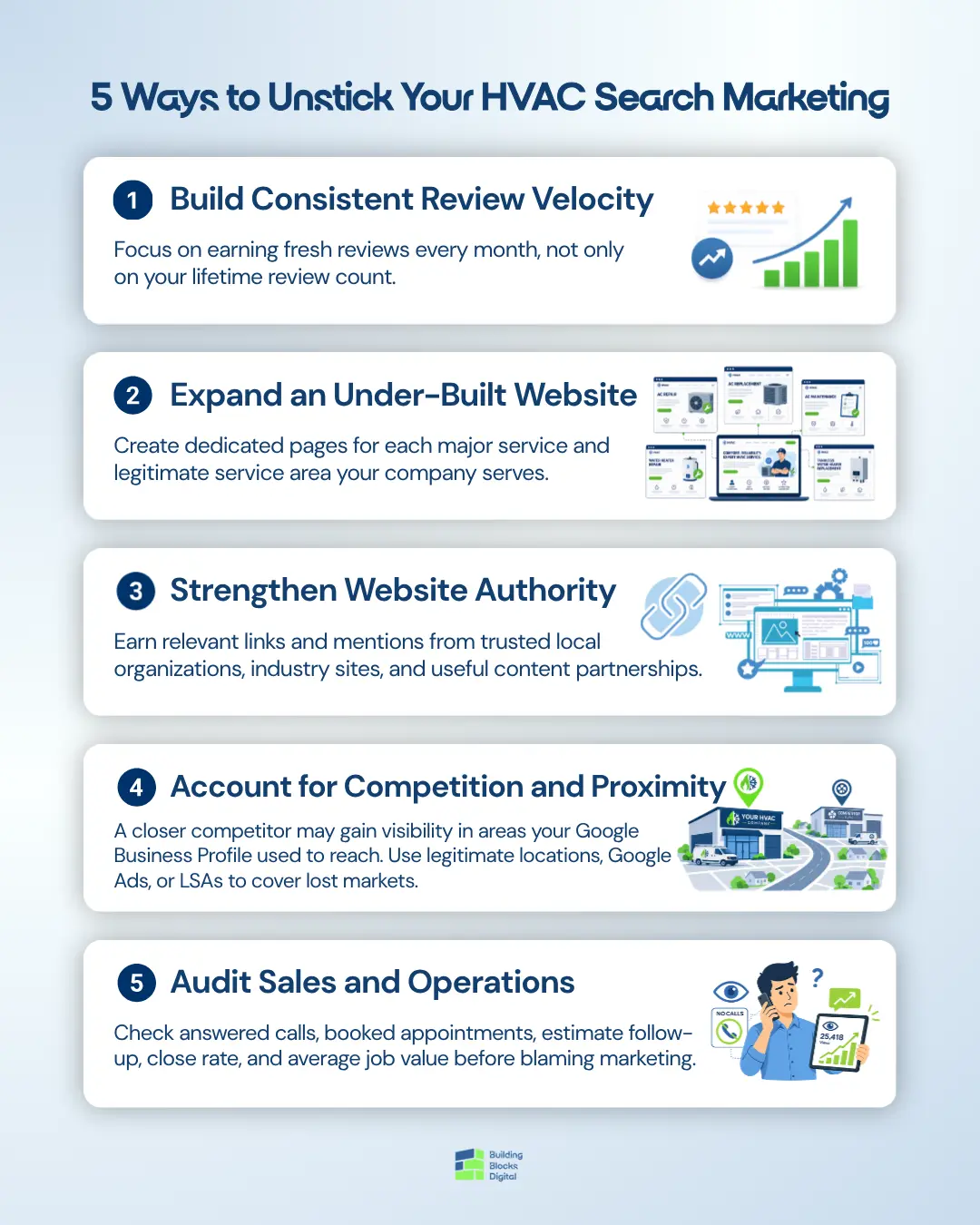
2. Expand an Under-Built HVAC Website
The second thing I review is whether your HVAC website fully represents everything your business actually offers.
This is one of the most common problems I see. An HVAC company may have a professional-looking website with pages for heating, cooling, and maybe plumbing. From a customer’s perspective, it seems complete. From a search engine’s perspective, it may not clearly represent the full range of HVAC services you want to appear for in local search.
Broad service pages alone usually aren’t enough.
Create a Page for Each Major Service
If your company offers AC repair, AC replacement, AC maintenance, emergency HVAC repair, furnace repair, water heater repair, water heater replacement, tank water heaters, and tankless water heaters, each of those services deserves its own page.
Your HVAC website should help search engines understand every major service you provide, from air conditioning repair to other air conditioning services your team offers. The goal isn’t to publish as many pages as possible. It’s to accurately represent your business so both customers and search engines clearly understand what you do.
Each page should explain the service, answer common questions, and use clear, descriptive language that matches what potential customers are searching for.
Google also recommends a logical website structure with descriptive content, relevant keywords, and internal links that help users and search systems understand your most important pages.
Add Legitimate Service Area Coverage
Once your service pages are in place, the next step is making sure your website reflects the real markets you serve.
If your HVAC business works in several cities or communities, your website should include helpful pages for those service areas. Together, your service pages and location pages help strengthen the relevance of your Google Business Profile by showing where you work and what services you provide.
That doesn’t mean creating dozens of nearly identical pages that only swap one city name for another. Every service area page should provide useful information for local customers and accurately represent a legitimate market your business serves.
Now ask yourself: Does your HVAC website fully represent your services and service areas?
3. Strengthen Your Website With Relevant Links
The third thing I look at is whether your marketing team is building authority beyond your own HVAC website.
I’ve seen HVAC companies invest in a well-organized website with dedicated service pages, helpful content, and a solid local SEO strategy, yet they still struggle to improve their visibility in local search. One reason is that very few other websites mention or link back to them.
That’s a missed opportunity.
Relevant links from trusted organizations and industry websites can help search engines better understand your business and its place in the community.
Your HVAC company might earn a link from the local chamber of commerce, contribute an educational article about air conditioning services to a reputable home improvement website, or be featured by another respected local organization.
Press releases can also play a role, but I generally see them as a smaller part of the overall marketing strategy.
“You can have the most decked-out site, but if no other websites are talking about it, Google’s never gonna trust your site.”
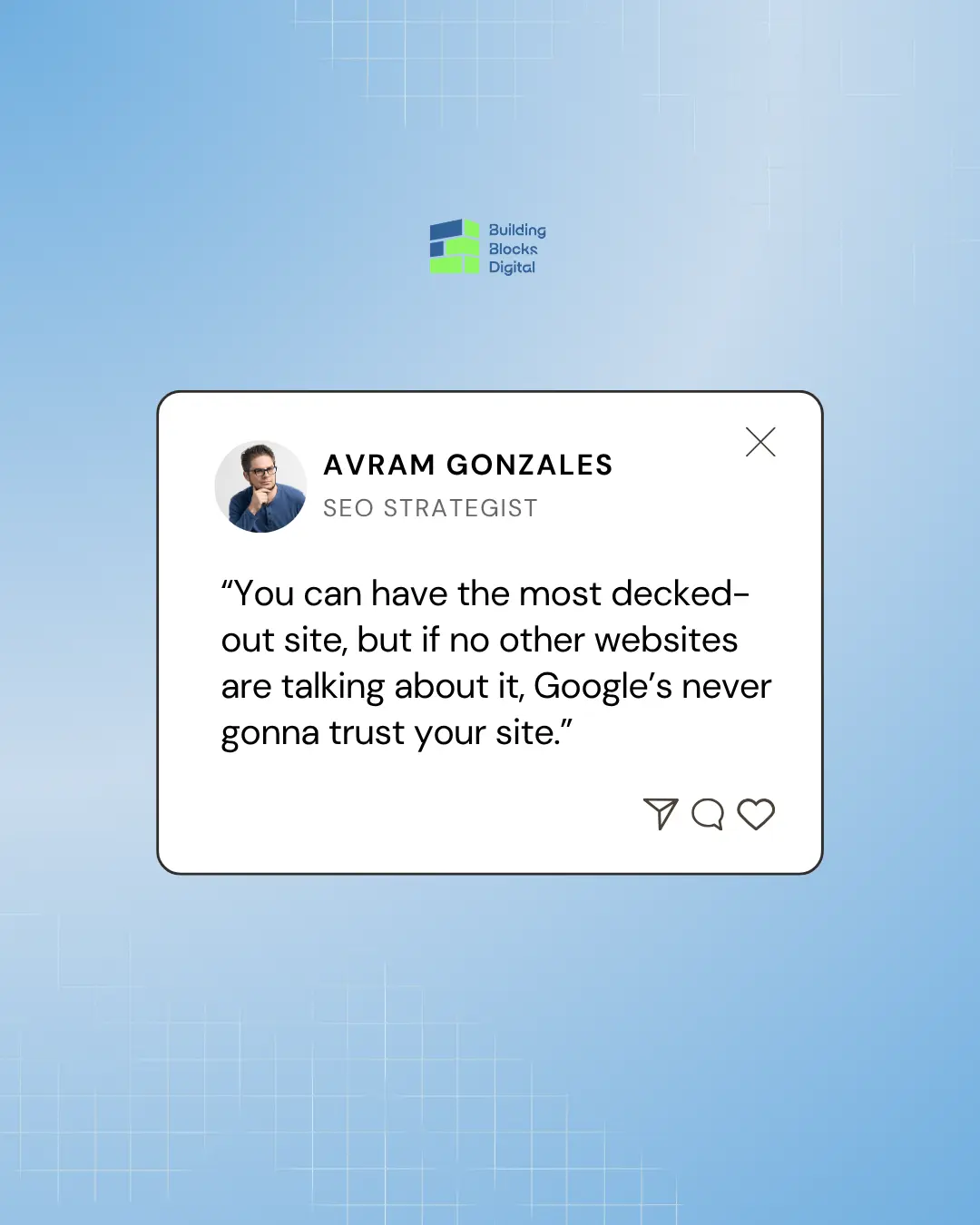
I wouldn’t take that as Google’s official wording, but it reflects what I’ve seen in practice. Google has long used links to discover content and better understand relationships between websites. That doesn’t mean every backlink improves search engine rankings or guarantees more leads. The quality and relevance of those links matter far more than the quantity.
That’s why I recommend earning links through legitimate business relationships, local organizations, and educational content instead of buying links or participating in link schemes that violate Google’s spam policies.
Building authority this way strengthens your digital marketing presence, improves brand recognition, and helps establish your business as a trusted resource within the HVAC industry.
While every AI platform works differently, many still rely on information from across the web. Strengthening your authority helps improve your business online, not just your visibility in Google Search.
One of the biggest reasons competitors outrank a better-looking website is stronger authority across the web. Learn more about how authority can help competitors outrank a better-looking website.
4. Account for Competition and Searcher Proximity
The fourth thing I look at isn’t always something you can control.
Sometimes your HVAC marketing strategy hasn’t changed at all. Your market has.
Google officially identifies relevance, distance, and prominence as the three primary factors that influence local search results. Distance is based on how close a business is to the person performing the search.
Here’s a situation I see fairly often.
Let’s say your HVAC company is located on one side of town, and you’ve consistently served customers in another ZIP code for years. Then your visibility begins to decline in that area.
It doesn’t always mean your local SEO has stopped working.
If another HVAC contractor opens closer to those potential customers, Google may simply view that business as the more relevant local option. I’ve seen this happen enough times that it’s one of the first things I investigate when a client tells me their visibility has dropped.
While I believe proximity plays a bigger role today than many business owners realize, Google hasn’t publicly confirmed a specific “proximity update” or revealed exactly how much weight distance carries compared to its other local ranking factors.
This has become even more noticeable as more people search on mobile devices, where Google Maps often prioritizes nearby local businesses and local service providers.
Use Other Marketing Channels to Reach More Customers
If your Google Business Profile isn’t reaching every market it once did, don’t assume you’ve run out of options.
Depending on your goals, it may make sense to open another legitimate business location, invest in Google Ads, or become more aggressive with Google Local Services Ads.
These marketing channels, including pay per click (PPC) and other forms of search engine advertising, can help you continue reaching local customers where organic visibility has become less dependable.
Google states that Local Services Ads consider factors such as customer location, relevance, responsiveness, ratings, and review count. If you’re already using LSAs, make sure your service areas accurately reflect where you operate. Here’s how to adjust Local Services Ads service areas.
If you decide to open another location, it must be a legitimate operating location. Virtual offices or unsupported Google Business Profiles don’t comply with Google’s guidelines and can create bigger problems down the road.
Before changing your marketing strategy, make sure you’ve identified the real problem. Sometimes it’s your marketing. Other times, it’s a more competitive local market.
5. Audit Sales and Operations Before Blaming Marketing
The last thing I look at has nothing to do with your HVAC website, Google Business Profile, or local SEO.
I look at what happens after the phone rings.
One of the biggest mistakes I see business owners make is assuming every drop in revenue is a marketing problem. Sometimes that’s true. But sometimes your HVAC marketing strategy is still generating opportunities, and your business isn’t converting them.
As HVAC businesses grow, it’s common for systems to become harder to manage. Calls get missed. Dispatch gets overwhelmed. CRM records aren’t updated. Comfort advisors don’t consistently follow up on estimates.
None of those problems are caused by marketing, but every one of them can reduce revenue and make it seem like your lead generation has slowed.
Marketing can generate qualified opportunities, but it can’t answer the phone or close the sale.
Start With Answered Calls and Booked Appointments
The first place I audit is your front-end process.
Is every call getting answered? Is dispatch booking qualified appointments? Or is your team assuming missed calls were probably spam?
One of our clients received more than 700 phone calls in a single month. Do you know how many they missed?
Only three.
That’s the kind of consistency it takes to keep opportunities from slipping through the cracks.
You don’t know whether a caller is a real customer or spam until someone answers. Every missed call is a missed opportunity to serve another customer and improve your local sales.
Google also states that responsiveness can influence Google Local Services Ads, making this both an operational and a marketing issue. For more ways to improve your LSA performance, read 5 Best Practices for Google Local Service Ads.
Compare Estimates and Close Rates Year Over Year
Next, I look at what happens after an appointment is booked.
How many estimates are you sending? How consistently is your team following up? Has your close rate changed compared to the same period last year? I also like reviewing average job value because it provides additional context. If your close rate remains steady but the average ticket has declined, the issue may have little to do with marketing.
These numbers tell an important story.
If your call volume and estimated volume remain steady but your close rate falls, the issue may be sales. If qualified opportunities are declining, your HVAC marketing strategy or local search visibility may need attention. And if calls are coming in but aren’t being answered or booked, you’re losing business before your sales team ever has a chance to help.
Decide Whether Your Marketing Team Is Keeping Pace
After reviewing these five things, you should have a much clearer picture of what’s happening.
Is your search marketing still generating opportunities? Has your business gradually lost visibility month after month or year over year? Is your current marketing team adapting to changes in local search, or are they relying on the same strategies they’ve used for years?
If you can’t clearly explain why performance has changed, it’s worth getting a second opinion.
A good marketing partner should be able to separate marketing problems from sales and operational issues, identify where your business is losing momentum, and recommend practical next steps. That’s very different from promising guaranteed rankings or more leads.
Find Out Whether Your Search Strategy or Operations Are Holding You Back
If your HVAC search marketing strategy isn’t delivering the same results it once did, don’t assume you need to start over.
Take a closer look at your online reviews, your HVAC website, the authority you’ve built across the web, changes in your local market, and how your team handles every opportunity your marketing creates. Looking at each of these areas will help you determine whether the issue is marketing, competition, sales, or operations.
If your HVAC business has been losing ground month after month or year over year, I’d encourage you to get a second opinion.
At Building Blocks Digital, we’ll review your current strategy, learn about your goals, identify gaps, and help you understand what may be holding your business back. Instead of guessing, you’ll leave with a clearer understanding of what needs to change next.
Ready for a second opinion? Book a search marketing review with Building Blocks Digital.
Frequently Asked Questions
How can an HVAC company improve its local search rankings?
Keep your Google Business Profile updated, earn online reviews consistently, and build an HVAC website that clearly represents every service you offer. Together, these efforts can strengthen your local SEO and improve your visibility in local search over time.
How often should an HVAC company receive new online reviews?
Google doesn’t recommend a specific number of reviews. Instead, focus on consistently asking satisfied customers for honest feedback so your Google Business Profile reflects recent customer experiences.
Does an HVAC website need a separate page for every service?
Yes. Dedicated pages for services like AC repair, furnace repair, and water heater replacement help search engines and potential customers better understand what your HVAC company offers.
Why does an HVAC company rank in some ZIP codes but not others?
Google considers relevance, prominence, and distance when displaying local search results. If another HVAC company is closer to the searcher, it may appear higher even if your local SEO hasn’t changed.
How can business owners tell whether declining HVAC leads are a marketing or sales problem?
Review your call volume, booked appointments, estimates, follow-up, and close rates. If opportunities are steady but conversions are down, the issue may be sales or operations rather than your HVAC marketing strategy.