Step 3. Account for Seasonality and Market Conditions
Before concluding that your HVAC SEO has stopped working, adjust your numbers for factors your marketing can’t control. Weather, customer demand, and the economy all influence how often people search for HVAC services, even when your local SEO and search visibility remain strong.
Start with seasonality. Ask whether the cooling or heating season started earlier, later, or was milder than usual. Also consider whether homeowners had the same need for AC repair, furnace repair, or emergency HVAC service.
I’ve seen cooling seasons arrive 45 to 60 days later than expected. I’ve also seen mild winters reduce furnace repairs and replacements.
In situations like these, lower call volume doesn’t automatically mean your SEO for HVAC or local SEO strategies have become less effective. Sometimes people simply don’t need service yet.
Next, look at the economy. Even when potential customers need a new system, they may hold onto their cash longer or delay a major purchase because of higher financing costs.
Instead of replacing aging equipment, many homeowners choose a repair to keep it running another season.
That’s why I don’t judge SEO performance by replacement sales alone.
Compare your service-call volume with the same period last year. If replacement jobs are down but service calls remain steady or increase, customer behavior may have changed—not your SEO efforts. Your HVAC website, Google Business Profile, and local search rankings could still be generating consistent demand, even if the type of work has shifted.
If both qualified organic inquiries and service calls have declined year over year, it’s time to take a closer look at your HVAC SEO strategy and overall digital marketing performance.
The goal is to separate changes in customer demand from changes in search engine optimization. Once you account for seasonality and market conditions, you’ll have a clearer picture of whether your marketing is underperforming or simply responding to a changing market.
Step 4. Separate Performance by Channel and Remove Spam
Once you’ve accounted for seasonality and market conditions, determine which marketing channels are actually generating your calls and qualified leads. Looking at total lead volume alone won’t tell you whether your HVAC SEO has stalled.
For example, your overall call volume might stay the same while organic traffic declines because Local Services Ads, Google Ads, or referrals are generating more business. If you combine every lead into one report, a stronger channel can hide a weaker one.
That’s why I separate every lead source.
Review your results from:
- Organic website traffic
- Google Business Profile
- Local Services Ads
- Google Ads
- Referrals
- Other tracked marketing channels
Then compare each one with the same month and quarter from the previous year.
I’ve noticed that Local Services Ads are producing leads more easily for some HVAC companies than they did in previous years. If most of your new business is coming from LSAs, paid advertising, or referrals while your HVAC website and Google Business Profile remain flat, your local SEO efforts may have plateaued.
This is also why channel-level reporting matters. You shouldn’t combine local SEO, paid advertising, referrals, and other campaigns into one marketing total. Each channel tells a different story, and each should be evaluated on its own.
Another issue I see is spam.
Spam calls often show up in Google Business Profile and organic call-tracking reports but not in Local Services Ads or Google Ads reports. At first glance, your reports may suggest that organic activity has increased when, in reality, many of those calls aren’t legitimate business opportunities.
One common example is callers claiming your Google Business Profile isn’t verified or trying to sell unnecessary marketing services.
Instead of relying on call totals, pick one month of recordings and review every call. Mark each one as:
- Spam
- Repeat customer
- Existing customer
- Genuine new lead
Once you’ve removed spam, recalculate your organic lead totals. The results will tell you whether your Google Business Profile optimization and HVAC local SEO are bringing in more real inquiries, staying flat, or simply generating more unwanted calls.
If your reporting doesn’t separate channels or allow you to review lead quality, it’s almost impossible to measure SEO success accurately. You don’t just need more leads; you need to know where they came from and whether they’re becoming paying customers.
If you’re already using Local Services Ads, our guide on How to Read and Interpret Your Google LSA Reports can help you understand which leads are worth your investment and how they compare with your organic search performance.
Step 5. Check Proximity, Review Velocity, and New Competitors
If everything else checks out but your HVAC SEO still appears to have stalled, this is the final place I’d look. At this point, the issue may not be your HVAC SEO strategy at all. It could be your local search environment.
Compare Your Google Business Profile’s Location With the Areas You Want to Serve
Start by looking at where your Google Business Profile is physically located. Then compare it with the neighborhoods you want to serve and where your local customers are searching.
If another HVAC company is located between your business and the customer, Google may show that competitor first because it’s closer to the searcher. This is one of the biggest reasons local search rankings can plateau, even when your SEO efforts remain consistent.
“In local search, proximity matters. If your business isn’t close to the searcher, it becomes much harder to win that customer through Google.”

The farther your business is from the person searching, the more difficult it can be to appear in Google Search, Google Maps, and other local search results. If you’re seeing weaker performance in one part of town, compare your location with the businesses ranking there before assuming your HVAC SEO has failed.
Consider Whether a Second Location Fits Your Business
For established HVAC businesses, a legitimate second location may help you reach homeowners on the other side of town or in a nearby suburb.
I’ve seen this strategy produce significant results for our clients. In one HVAC Local SEO campaign, a strategically placed second Google Business Profile contributed 60% of more than 1,000 additional year-over-year phone calls.
See how we implemented this approach: HVAC and Plumbing Local SEO Case Study: 1,042 New Calls in One Year
Compare Review Velocity With Competitors
Your online reputation isn’t measured only by your total number of Google reviews.
I also look at review velocity, the number of new reviews your business earns over time.
A company with hundreds of reviews that rarely receives new feedback may struggle against a competitor that consistently collects fresh reviews every month. That’s why I compare review activity across businesses in the same market instead of focusing only on total review count.
If you’re looking for ways to strengthen this area, our guide on How Reviews Impact Google Maps Rankings explains why consistent customer feedback matters.
Look for New Competitors in Formerly Strong Areas
Finally, look at the neighborhoods where your business used to perform well.
Have new HVAC companies opened nearby? Have competitors established Google Business Profiles closer to the homeowners you’re trying to reach?
As more businesses enter your market, they may gain visibility simply because they’re closer to the searcher. That doesn’t necessarily mean your SEO has stopped working. It may mean your local search environment has changed.
Sometimes a plateau isn’t caused by poor SEO. It’s the result of a more competitive market that requires a smarter search strategy.
Use This HVAC SEO Plateau Checklist
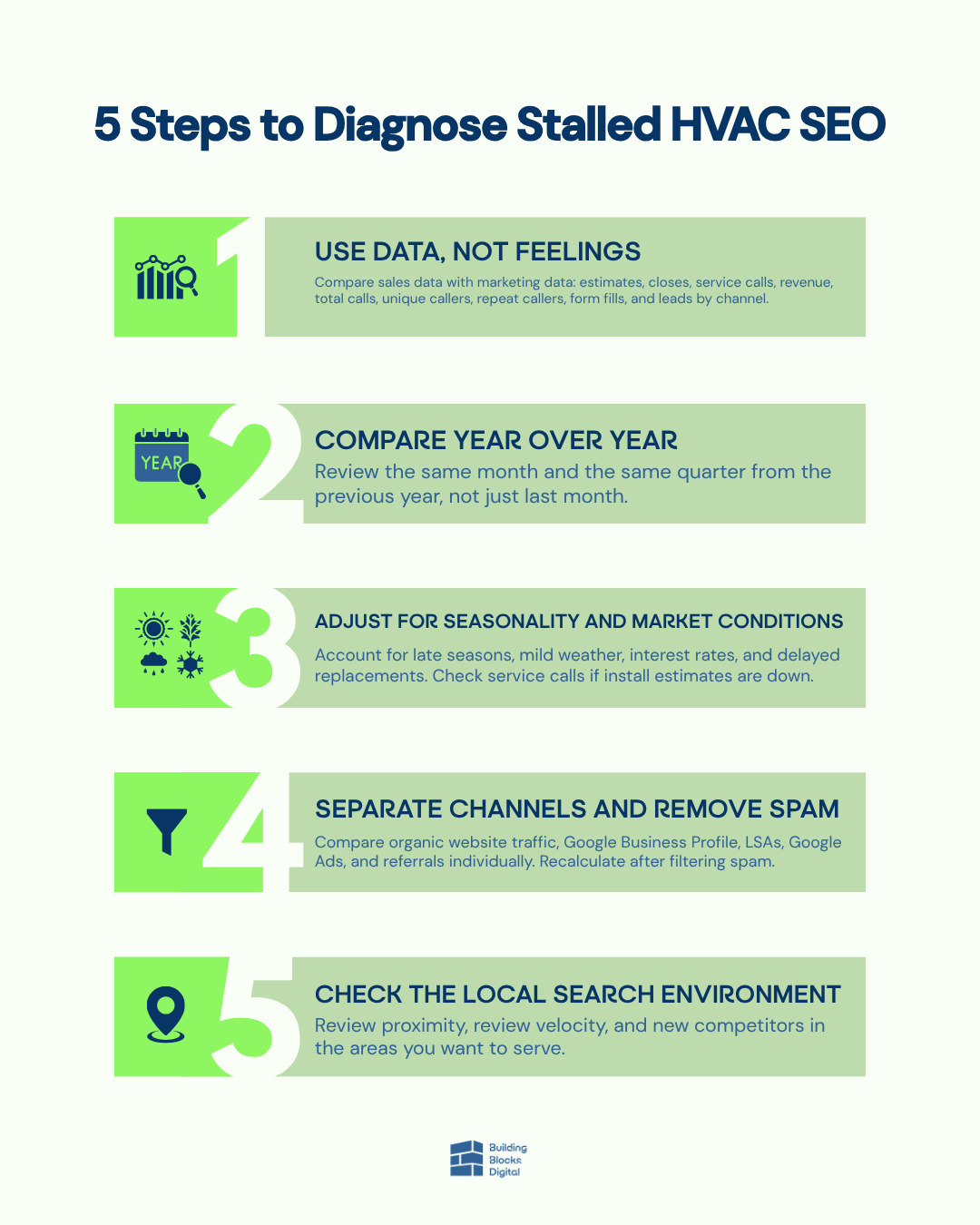
Before changing your HVAC SEO strategy, check the following:
- Compare sales and marketing data.
- Verify where your qualified leads are coming from.
- Compare the same month and quarter from the previous year.
- Account for seasonality, weather, and economic conditions.
- Separate results from Google Business Profile, Local Services Ads, Google Ads, referrals, and your HVAC website.
- Remove spam before measuring organic traffic and lead quality.
- Check proximity, local search rankings, review velocity, and competitors.
- Confirm the issue is your HVAC SEO—not customer demand or another marketing channel.
Put Your HVAC SEO Back on a Measurable Path to Growth
If your HVAC SEO appears to have stalled, don’t assume it’s time to replace your marketing strategy. Start with the data. Compare year-over-year performance, account for seasonality, separate your marketing channels, remove spam, and evaluate your Google Business Profile and local competition.
The goal isn’t to chase rankings. It’s to understand where your qualified leads come from and whether your SEO efforts are driving measurable business growth.
Don’t make changes until you know what’s causing the slowdown. Explore our Local SEO services or call Building Blocks Digital at (505) 365-1545. We’ll diagnose the problem and show you where your biggest opportunities are.
Frequently Asked Questions
Why has my HVAC SEO stopped working?
Not every drop in Google Search results means your HVAC SEO has failed. Seasonality, economic conditions, new competitors, spam calls, and changes to your Google Business Profile can all affect visibility. Before changing your HVAC SEO services or trying new HVAC SEO tips, compare year-over-year data to determine what’s actually causing the slowdown.
How long should it take to see results from HVAC SEO?
A successful SEO strategy takes time. Most HVAC businesses begin seeing measurable improvements over several months, but meaningful growth should be evaluated year over year. Track Google Search Console, Google Analytics, and lead data together to measure real business results instead of rankings alone.
How can I tell if my SEO traffic is producing real leads?
Track every lead source separately and compare marketing data with sales results. Review call recordings, remove spam, and measure how many HVAC customers become booked service calls or paying customers. Monitoring Google Search Console alongside your call tracking can help you understand how your organic traffic contributes to revenue.
Does my Google Business Profile location affect where I rank?
Yes. Your location directly affects Google Search results, Google Maps, and other local search results. Along with maintaining an optimized profile, continue to optimize your Google Business with fresh online reviews, accurate business information, and updated service pages that target your service area.
Can new competitors cause my Local SEO rankings to drop?
Yes. As more businesses enter your market, they may become more relevant to nearby searchers. Continue improving your local keywords, publishing helpful content, earning online reviews, and updating your service pages so your business stays competitive in local search.