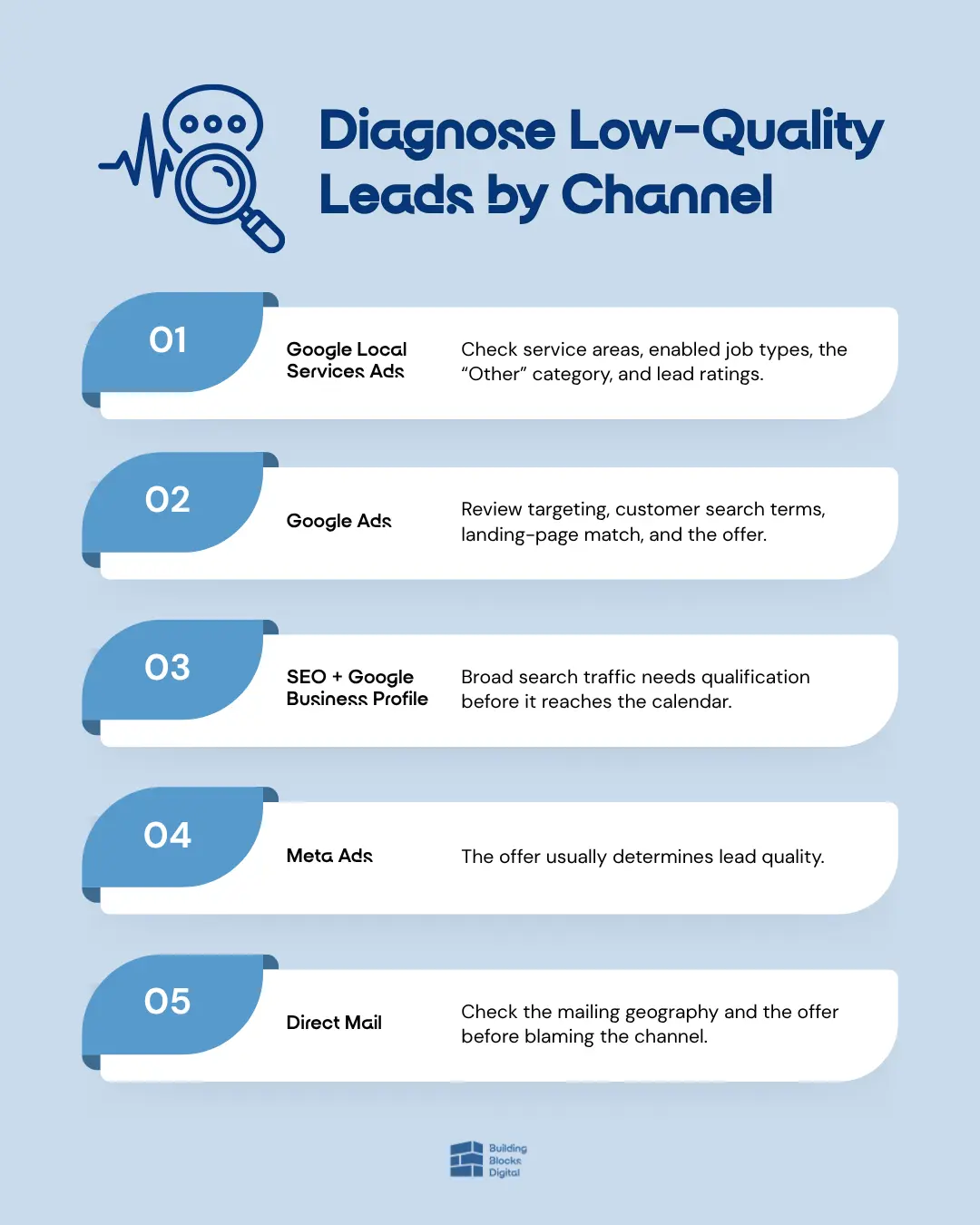
Diagnose Low-Quality Leads by Marketing Channel
Once you understand the prospect’s intent, the next step is identifying where the lead came from. Don’t treat every poor lead the same. Each marketing channel has different strengths, weaknesses, and common causes of low lead quality.
Here’s what I check before making changes.
Google Local Services Ads: Check Service Areas, Job Types, and Lead Feedback
When I review Google Local Services Ads, I start with the account settings.
First, review your service area. Make sure you’re only targeting locations you actually serve. If you’re getting inquiries from the wrong neighborhoods, remove those areas.
Next, review your HVAC or plumbing job types. Confirm you’ve only enabled the services you provide. I also recommend checking the Other category. If you’re receiving requests that don’t fit your business, disabling that option may improve your results.
Finally, rate every lead you receive. Telling Google which leads were good and which weren’t helps improve future matching. Without that feedback, Google has less information about what your business considers a quality lead.
Before deciding Google Local Services Ads aren’t working, make sure your account targets the right service area, the correct services, and that you’re consistently rating your leads.
Our guide, How to Configure Google LSA for HVAC and Plumbing Businesses, shows you how to optimize your account.
Traditional Google Ads: Check Targeting, Search Terms, Landing Pages, and Offers
Google Ads can generate excellent qualified leads, but only if the campaign matches how homeowners actually search.
Start by reviewing your targeting. Are your ads reaching the right locations and audience? Small mistakes can increase your customer acquisition cost without improving results.
Next, look at the search terms. One mistake I see from many HVAC contractors is using industry language instead of customer language.
You may call it “refrigerated air,” but homeowners search for “air conditioning” or “AC repair.” Using the right high-intent keywords helps attract people actively looking for HVAC services.
Then review your landing page. It should match the message and offer in the ad. If there’s a disconnect, visitors are less likely to trust your business.
Your landing page should also include customer testimonials and trust signals that support the offer and improve conversion rates across your paid channels.
Finally, evaluate the offer. Deep discounts may bring in more leads, but they also attract homeowners contacting multiple companies for the lowest price. Sometimes the offer—not Google Ads—is what’s producing low-quality leads.
Traditional SEO: Qualify Broad Search Traffic Before Booking It
Traditional search includes leads from your website, Google Business Profile, and local SEO.
Keep your business hours, contact information, and positive reviews updated so both new customers and existing customers know exactly when and how to reach you.
A strong local search engine optimization strategy can attract plenty of traffic, but not every visitor will be a good fit. That’s normal. You can’t stop every tire kicker from finding your business.
Instead, focus on qualification.
Train your dispatch team to ask the right questions during phone calls before scheduling appointments. Confirm the caller is inside your service area, needs a service you provide, and is serious about moving forward.
Your website can help too. Contact forms should gather enough information to identify qualified leads before they reach your calendar. If your business charges a dispatch fee, make that expectation clear during scheduling.
Traditional search can consistently generate leads, but your dispatch process determines which inquiries become real opportunities.
Meta: Check Whether the Offer Attracts the Wrong Prospect
Meta includes Facebook, Instagram, WhatsApp, and the rest of Meta’s advertising platforms. When I review lead generation from these channels, I focus on the offer before anything else.
Unlike search leads, these prospects weren’t actively looking for HVAC services. Your ad interrupted what they were doing, so the type of offer you present matters.
Deep discounts often attract people looking for the cheapest option. Those prospects are more likely to contact multiple companies and compare prices instead of hiring based on value.
Instead, think about who your offer attracts. For example, an indoor air quality offer or an urgent emergency AC repair service may appeal to homeowners with a more immediate need.
The goal isn’t to find one perfect offer, it’s to attract the right potential customers for your HVAC business.
If Meta is producing weak leads, review the offer before giving up on the platform.
Direct Mail: Check the Geography and the Offer
Many HVAC companies focus heavily on digital marketing, but direct mail can still be an effective way to generate HVAC leads.
When direct mail produces poor lead quality, I usually find one of two problems.
The first is geography. Review where you’re sending your mailers. Are those neighborhoods a good fit for your services and pricing? Sending offers to the wrong audience makes it harder to attract paying customers.
The second is the offer. Like Meta, heavily discounted promotions often attract price shoppers. A stronger offer positions your business against the competition instead of encouraging homeowners to compare the lowest price.
If direct mail isn’t working, start by reviewing your mailing areas and your offer before writing off the channel.
What to Check First Across Every Lead Source
After reviewing each marketing channel, take a step back and evaluate your overall qualification process. Whether your leads come from Google Local Services Ads, Google Ads, local SEO, Meta, or direct mail, every lead should go through the same screening process.
Track Every Lead by Channel
If you don’t know where your leads come from, you’re guessing.
Track each channel separately and monitor total leads, qualified leads, booked appointments, sold jobs, and cost per qualified lead. These key performance indicators help you understand which channels actually produce revenue.
Don’t compare Meta with search leads using the same expectations. They attract different types of prospects.
Also, look for problems after the lead arrives. Poor follow-up systems, slow response times, and missing calls can prevent your team from converting leads, even when the marketing is working.
A good marketing report should show where every lead came from, whether it qualified, whether it booked, and whether it became a customer. Without that information, you can’t optimize your paid advertising budget or know what’s driving results.
Consider a Dispatch Fee Before Sending a Technician
One of the simplest ways to improve lead quality is to qualify prospects before your technician leaves for the appointment.
“If you’re charging a dispatch fee before sending a technician to give an estimate, you’ll automatically filter out people who are super price sensitive.”
Even a modest $30 dispatch fee creates a commitment before the visit. Someone unwilling to pay a small fee may simply be collecting free estimates rather than looking to hire an HVAC service company.
A dispatch fee isn’t a cure-all. It won’t fix poor targeting, a weak offer, or inadequate dispatch training. However, it can reduce wasted service calls and protect your team’s schedule.
Explain the fee during the dispatch call, on your scheduling page, or before confirming the appointment.
No matter where the lead came from, better qualification helps your team spend more time with serious potential customers.
Diagnose the Source Before You Chase Better HVAC Leads
When most HVAC leads seem low quality, don’t assume you need a different marketing channel. Start by identifying the lead’s intent, then determine where it came from.
Review each channel based on its most common issues:
- Google Local Services Ads: Check your service area, job types, and lead feedback.
- Google Ads: Review targeting, search terms, landing pages, and offers.
- Traditional SEO: Strengthen your dispatch process and website qualification.
- Meta: Audit the offer.
- Direct mail: Review your mailing geography and offer.
Once you’ve diagnosed the source, you can stop spending money on the wrong fixes and focus on attracting customers who generate greater customer lifetime value.
That’s how many HVAC businesses build repeat business, create more happy customers, and grow in today’s competitive HVAC industry.
Not sure what’s hurting your HVAC lead generation? Schedule a consultation with Building Blocks Digital or call (505) 365-1545. We’ll help you figure out what’s working, what’s not, and where to focus to get better-quality leads.
Frequently Asked Questions
Why are most HVAC leads low-quality?
Low lead quality often comes from the customer’s intent, the marketing channel, your offer, or how your HVAC business qualifies potential customers before booking service calls.
How can I generate high-quality leads for my HVAC business?
To generate HVAC leads that are more likely to become paying customers, start by identifying which marketing channels produce your best qualified leads. Then improve your targeting, offers, follow-up process, and lead conversion instead of simply trying to generate more leads.
How can Google Local Services Ads improve HVAC lead generation?
Google Local Services Ads can improve HVAC lead generation when your service area, job types, and lead feedback are set up correctly. Regularly reviewing your account helps attract better qualified leads and reduces poor-fit inquiries.
Why do Google Ads attract price shoppers?
Google Ads often attract price shoppers when the offer focuses too much on discounts. Using customer-friendly search terms, high-intent keywords, and a landing page that matches your ad can help attract homeowners who need HVAC services instead of people comparing multiple companies.
Does Local SEO help generate more qualified HVAC leads?
Yes. Strong local SEO, an optimized Google Business Profile, and well-written location-specific service pages help your business appear when homeowners actively search for AC repair, emergency AC repair, and other HVAC services. These search leads typically have stronger buying intent than interruptive advertising.
Should my HVAC business charge a dispatch fee?
A dispatch fee won’t solve every lead quality problem, but it can help filter out highly price-sensitive prospects before your technician is dispatched. Even a small fee can protect your schedule and give your team more time to focus on qualified leads.