Factor #2: What Stage of Maturity Has the Business Reached?
Your growth goals are only half the equation. The other half is your business’s stage of maturity.
A startup, a growing plumbing company, and an established HVAC business all have different needs. As revenue increases, so do trucks, payroll, operating expenses, and overhead. That changes how your marketing budget should work for you.
While the percentage of revenue you invest may change over time, one principle stays the same: your marketing efforts should never stop. They simply evolve as the business grows.
Startups Need to Build a Customer Database
New HVAC contractors and plumbing businesses often have one advantage: lower overhead.
What they don’t have is an established customer base.
That means every new customer matters. A homeowner who first hires you for HVAC services could become a maintenance customer for years before eventually replacing their system. A single service call can grow into thousands of dollars in lifetime value.
That’s why early-stage businesses often need to invest aggressively enough to build both current revenue and future opportunities.
Marketing at this stage isn’t just about filling next week’s schedule. It’s about building a database of loyal customers who generate repeat business over time.
Trying to save money by cutting your marketing spend too much can slow that process. Without a consistent effort to reach potential customers, it becomes harder to create the steady lead flow every growing contractor needs.
Check out our guide on the Top 4 Marketing Channels for HVAC Startup Businesses Under $500,000. It explains how channel priorities change as businesses grow.
Growing Companies Need to Support More Trucks and Payroll
As your business expands, the financial picture changes.
More trucks are on the road. More technicians are on payroll. Operating costs increase, and margins often become tighter.
Growth creates new opportunities, but it also creates more responsibility.
Your marketing investment now has another job: keeping those trucks busy.
Adding capacity without creating enough demand can leave expensive assets sitting idle. On the other hand, investing wisely in digital marketing, Google Local Services Ads, Google Ads, local SEO, and other proven marketing channels can help maintain consistent demand as the company grows.
Revenue alone isn’t the number that matters.
Owners also need to understand what remains after payroll, overhead, and marketing costs are paid. A larger advertising budget should support profitable growth, not growth for its own sake.
The best marketing strategy considers both where the business is today and where the owner wants it to be tomorrow.
Mature Companies May Move Closer to 6% of Revenue
As some HVAC companies move beyond roughly $3 million to $5 million in annual revenue, the percentage allocated to marketing may decrease to around 6%.
That doesn’t mean marketing becomes less important.
It simply reflects that mature businesses often have stronger brand recognition, a larger customer base, more repeat business, and more referrals than they did in their early years.
For example:
- A company generating $3 million in annual revenue would invest about $180,000 per year at 6%.
- A company generating $5 million in annual revenue would invest about $300,000 per year at 6%.
These figures are simple calculations based on the recommended percentage, not fixed budgeting rules.
The next question isn’t whether to keep investing. It’s how to allocate that budget across the right marketing channels for your current stage of growth.
Mature Companies Still Need to Defend Market Share
One mistake established contractors sometimes make is assuming they can reduce marketing because they’ve already built a successful business.
The reality is different. Competitors continue investing. New home service companies enter the market every year. In many areas, private-equity-backed businesses are deploying significant marketing dollars to capture customers and expand their presence.
That means established companies can’t afford to become invisible.
“As your business grows, your marketing budget may change, but you still need to keep the engine going.”

A mature company may invest a smaller percentage of gross revenue than it did during its startup years, but marketing remains essential for protecting market share, maintaining consistent lead flow, and supporting long-term growth.
The percentage may change as the business grows. The need for marketing does not.
If you’re unsure where to start, use this simple framework below to build a realistic HVAC marketing budget that matches your business.
Use This HVAC and Plumbing Marketing Budget Framework
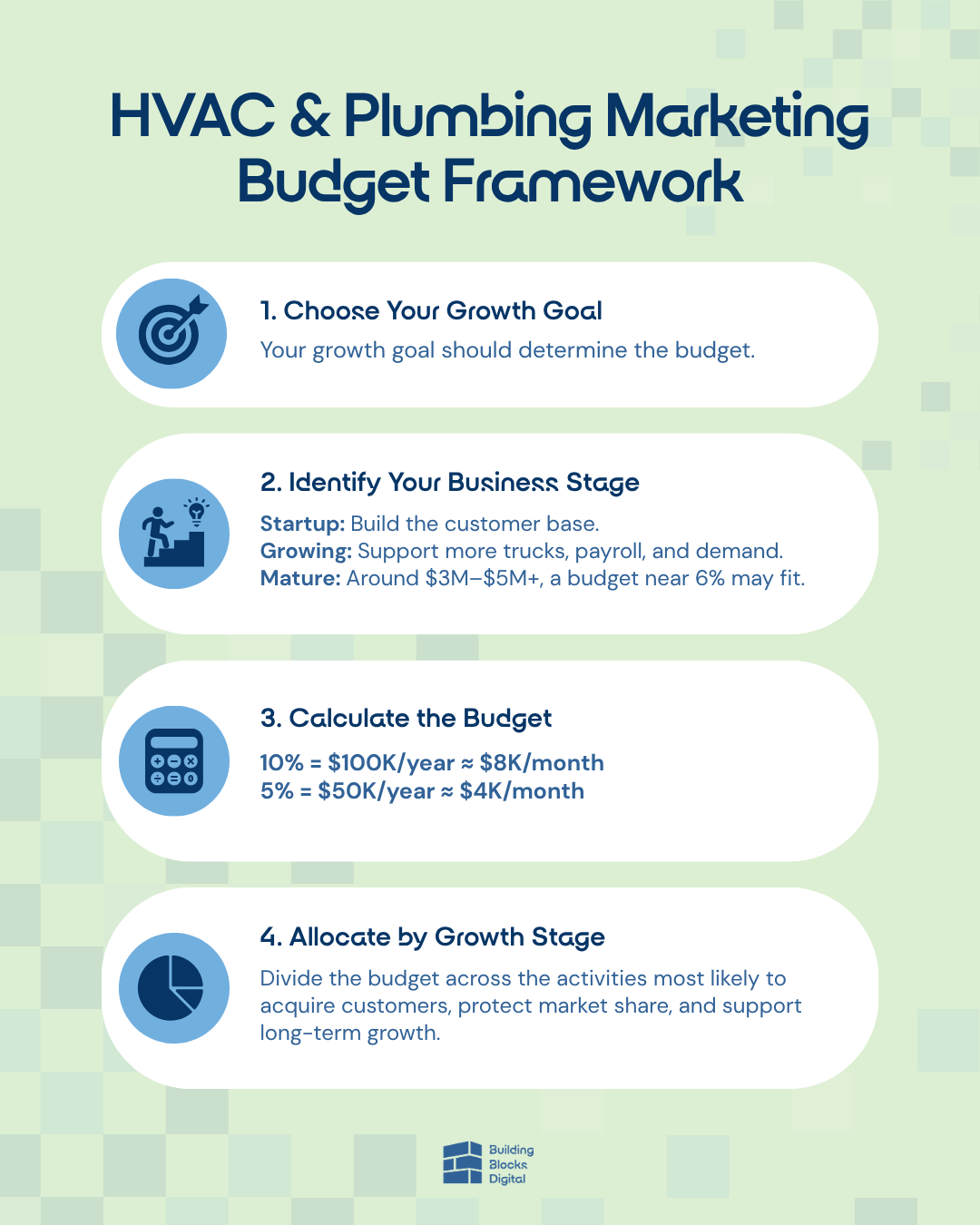
1. Choose Your Growth Goal
Start by deciding how aggressively you want to grow.
If your goal is to expand quickly, add trucks, or enter new service areas, consider investing up to 10% of your annual revenue in marketing.
If your goal is steady, sustainable growth, a more conservative approach may be appropriate. Even then, it’s generally wise to avoid dropping below 5% of annual revenue. That level helps support ongoing lead generation, keeps your business visible in local search, and maintains a consistent flow of potential customers.
Your growth goal should drive your marketing budget, not the other way around.
2. Identify Your Business Stage
Next, look at where your business is today.
- Startup: Focus on acquiring customers and building a customer base that creates repeat business over time.
- Growing business: Support additional trucks, payroll, and operating capacity with enough marketing to generate consistent demand.
- Mature business: Once you’re above roughly $3 million to $5 million in annual revenue, a budget closer to 6% may make sense while continuing to protect market share and strengthen your local presence.
Every stage has different priorities, but every stage still requires ongoing marketing.
3. Calculate Your Annual and Monthly Budget
Once you’ve selected a percentage, the math is straightforward.
For a business generating $1 million in annual revenue:
- 10% budget: $100,000 annually, or about $8,000 per month
- 5% budget: $50,000 annually, or about $4,000 per month
These numbers provide a planning baseline. As your business grows, regularly review your budget to ensure it still aligns with your goals and financial position.
4. Decide How to Allocate the Budget
After setting your total marketing budget, decide how to divide it across the marketing channels that best fit your stage of growth.
Rather than choosing channels based on trends, build a marketing plan around the activities most likely to help you acquire customers, maintain market share, and support long-term growth.
A good budget isn’t just a percentage of revenue. It’s a plan that connects your annual revenue, growth goals, business maturity, and overall marketing strategy.
Set a Marketing Budget That Matches the Growth You Want
There isn’t one good marketing budget for an HVAC or plumbing company. It should reflect your growth goals and your stage of business maturity.
If you’re pursuing aggressive growth, investing up to 10% of annual revenue may help you capture more customers and expand faster. For a more conservative approach, a budget of 5% or more is generally recommended. As your company grows beyond roughly $3 million to $5 million in annual revenue, a budget closer to 6% may be appropriate.
Once you’ve set your budget, the next step is putting those marketing dollars to work in the right channels.
Schedule a discovery call with Building Blocks Digital to review your revenue, growth goals, business maturity, and marketing investment. We’ll help you build a marketing budget that supports your goals and positions your business for a successful season. Contact us online or call (505) 365-1545.
Frequently Asked Questions
What is a good marketing budget for an HVAC or plumbing company?
A good marketing budget for an HVAC or plumbing company depends on your growth goals, annual revenue, and business stage. Many HVAC companies and plumbing companies invest between 5% and 10% of annual revenue, while some mature businesses may settle closer to 6%.
How much should an HVAC company spend on marketing?
Most HVAC companies should base their marketing budget on their total revenue, growth goals, and business maturity, not what another contractor spends. A realistic marketing budget should generate consistent demand while supporting profitable growth.
Is 5% of annual revenue enough for an HVAC marketing budget?
For many HVAC businesses and plumbing businesses, 5% of annual revenue is a solid starting point for a conservative HVAC marketing budget. Companies focused on faster growth or expanding into competitive markets may need to invest more.
Should a new HVAC or plumbing company spend more on marketing?
Yes. New HVAC contractors and plumbing companies often need stronger marketing efforts to build a customer base, generate leads, and create repeat business. Investing early helps lay the foundation for long-term growth.
How should an HVAC company allocate its marketing budget?
Once you’ve set your HVAC marketing budget, invest in the marketing channels that match your business stage and goals. Many home service companies prioritize Google Local Services Ads, Google Ads, Google Business Profile, and local SEO to generate consistent demand.